Last week, we talked about places where history seems to be standing still. There are places in our country that inhabit their physical surroundings, virtually unchanged for hundreds, if not thousands, of years.

Padre Island National Seashore is one of those places. In the early 1800’s, Spain was the first to lay claim to the island, followed by Mexico, which owned the island from 1821 through 1836, at which point, the Republic of Texas claimed the land between the Nueces River and the Rio Grande. Finally, the United States wrested ownership of the island after acquiring the territory of the Republic of Texas in the mid 1800’s. Of course, the history books neglect to mention that prior to the various entities claiming ownership of the island, the indigenous people of the Karankawa were there first. The Karankawa were a nomadic group that traveled along the coastline of the barrier islands. Their traditional lands ran from Galveston Bay to the Bay of Corpus Christi. The Karankawa are first entered into the historical records in1528 when a Spanish ship wrecked on an island, near Galveston, that was inhabited by the Karankawa. Álvar Núñez Cabeza de Vaca, who was one of the shipwrecked sailors stranded on the islands, became one of the first people to provide a written history of the indigenous people and of Texas. In the mid 1700’s, there were several attempts by the Spaniards to “missionize” (code word for relocate and steal land from) the Karankawa but the fight to steal the lands lasted until the early 1800’s when military actions and smallpox decimated the population of the Karankawa. For more detailed history on the Karankawa, check out this post on the Texas State Historical Association’s website.
Padre Island has been known by many names over the years. It is currently known as Padre Island after Padre Nicolas Balli, a Spanish priest who settled there in 1804. Prior to being known as Padre Island, it was also known as La Isla Blanca (White Island) and Isla de los Malaguitas (Island of the Malaquites–a band of the Karankawa). Another interesting historical note about Padre Island is that from World War II to the1960’s, the island had a Navy bombing range on the northern tip of the island, which makes sense considering there is a naval base at nearby Corpus Christi.
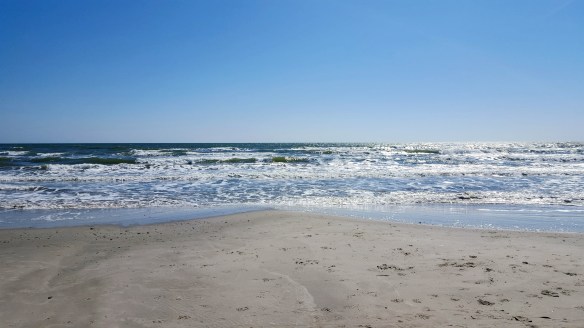

Padre Island was established as a National Park Service in 1962 and was dedicated by Lady Bird Johnson. It is one of ten national seashores under the National Park Service banner. Padre Island has the longest stretch of undeveloped barrier island in the world! Today, Padre Island National Seashore is a nature lover’s paradise! The National Seashore is home to hundreds of plants, animals, and birds. There are over 400 species of flowering plants. Padre Island and the surrounding area provides over “380 migratory, overwintering, and resident bird species (nearly half of all bird species documented in North America),” a habitat that includes prairies, dunes, tidal flats, and a hypersaline lagoon environment known as The Laguna Madre (the mother lagoon). Thirteen of these species are considered species of concern, threatened, or endangered. Birders come from all over the world to Padre Island National Seashore hoping to catch a glimpse of a rare or endangered bird.

And speaking of endangered, the Kemp’s ridley sea turtle, one of the most endangered sea turtle species in the world, nests on Padre Island’s shores from April to mid-July. This is one of the few places you can watch newly hatched babies get released into the wild! If you’re there between April and July, be on the lookout for red dots (reflective lollipop stakes) red flagging tape, or bright yellow flags with a turtle silhouette. This means there are turtle nests nearby and to be on the lookout! Also, if you spot a nest that hasn’t been marked, or if you see someone moving a reflector or tampering with a nest, do your part to save the turtles and report your sightings to 1-866-TURTLE5. Learn more about how you can help protect these turtles by visiting the NPS website about the Sea Turtles of Padre Island.
Padre Island National Seashore is open 24 hours a day, 365 days a year. If the entrance station is not open upon arrival, you are on the honor system and expected to pay the entrance fee on your way out. If you decide to camp there, you can go back to the station once it’s open and pay your camping fee then. The Visitor Center is open from 9a-5p every day of the year except for Thanksgiving and Christmas days. Beach accessible wheelchairs and walkers are available for use free of charge. They are available at the Visitor Center and are first come, first served.
MILE MARKER: Padre Island is the only place in Texas where 5 species of sea turtles exist: Kemp’s ridley sea turtles, green sea turtles, loggerhead sea turtles, hawksbill sea turtles, and leatherback sea turtles. If you’re interested, check here to find out when sea turtle hatchling releases will be scheduled. People come from all over the world to watch hatchlings make their way across the beach and back into the ocean.
HIKE IT!: Grasslands Nature Trail is a .75 mile loop located near the park entrance. The trail is paved and easy to walk on. This trail allows for sweeping views of the dunes and the grasslands, as well as various wildflowers, birds, and other wildlife. Because this trail is paved, it is also wheelchair accessible. Be sure to take water with you. Use bug spray if needed and don’t feed the wildlife!
 Two Chicks with Hiking Sticks
Thank you for this Super Fantastic synopsis! So educational too!
LikeLiked by 1 person
Thanks so much for taking the time to read and comment! We appreciate the feedback. 🙂
LikeLike