America was moving west and it wasn’t an easy trek. As settlers began making their way into and across the United States, there was a push to move westward in the 1800’s. Gold had been discovered, Spaniards were making inroads and discovering land and an abundance of natural resources. Places like Fort Davis were providing a safe respite from the wild west but it was taking time for get from one end of the country to the other. Wagon routes and months-long sea voyages were slowing progress. Many leaders—businessmen, politicians, and military planners—began calling for a faster, safer way to connect the nation, a nation dreaming of speed and connection.
But the idea stalled for years because Congress couldn’t agree on where the route should run. Northern states pushed for a northern path; Southern states demanded a southern one. The political deadlock broke only after the Civil War began, when Southern representatives (who preferred a southern route) withdrew from Congress. Suddenly, the northern-backed plan had a clear path forward.
In 1862, President Abraham Lincoln signed the Pacific Railway Act, officially launching the transcontinental railroad. The government supported it with land grants and loans, while two companies—the Union Pacific (building west from Omaha) and the Central Pacific (building east from Sacramento)—took on the construction. Their lines met in 1869 at Promontory Summit, Utah, forever transforming travel, trade, and the American West.
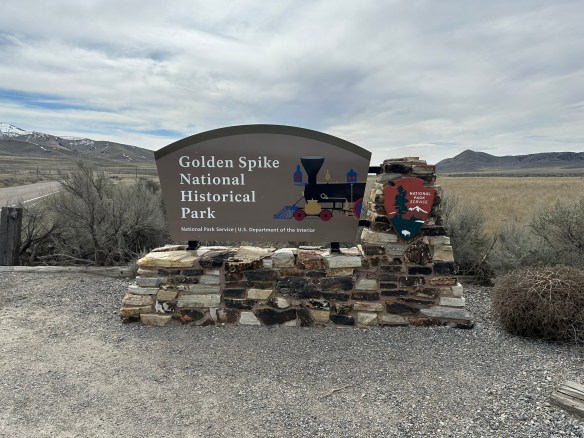
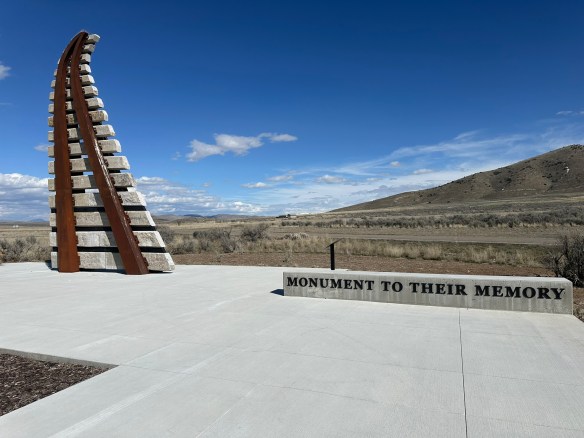
On May 10, 1869, officials from the Central Pacific Railroad and the Union Pacific Railroad met at PromontorySummit, in Box Elder County, Utah, to drive the final, ceremonial spikes, linking the eastern and western United States by rail. In 1965, the site of the last spike on the transcontinental railroad was designated a National Historic Site. In March of 2019, the park’s designation was changed from a historic site to a historic park, just in time to for the commemoration on May 10, 2019, as America celebrated the 150th anniversary of the completion of the First Transcontinental Railroad and recognizing the historic site as the Golden Spike National Historical Park.
Photo by S. Resendez
While connecting the railways was indeed a giant leap forward for the United States, it should be noted that these strides were made on the backs of several groups of people. Native Americans were already settled in the west and the construction of the railroad caused the people from 15 tribal nations to watch their homes and livelihood be destroyed with the advancement of the railroad. Irish immigrants, who came seeking work during potato famine in the mid-1800’s, were instrumental in helping build the railroad despite religious discrimination and.a language barrier. And Chinese immigrants, who were reluctantly hired after a critical shortage of labor was created due to gold strikes, were responsible for a great majority of the hardest labor that went into building the transcontinental railway. Chinese workers were often given tasked with working in the most dangerous conditions. Tunnels in the Sierra Nevada Mountains that had to be bored into solid granite for the railroad, rockslides, explosions, exposure, avalanches, and violent clashes claimed the lives of many of the Chinese workers. It is estimated that over one thousand Chinese laborers died building the CPRR. At the 1869 Golden Spike ceremony, not a single Chinese laborer was invited or mentioned, despite their indispensable role.
Central Pacific Railroad Jupiter Photo courtesy NPS
Today, Golden Spike National Historical Park offers a variety of things to do during your visit. Commemorative events, seasonal events, nature, and hiking are all available at this park. There are approximately 55,000 visitors a year and the visitor’s center is open seasonally, at various hours. Please check the website for specific information before your visit. The physical address is 6200 North 22300 West, Promontory, Utah. It is approximately 30 miles west of Brigham City. The park is 2,735 acres of land surrounding a 15 mile stretch of the original Transcontinental Railroad. There is only one paved road coming in to the visitor’s center.
MILE MARKER: Did you know that the famous golden spike wasn’t hammered into place at all—it was gently tapped, lifted back out, and sent home, while the real work of joining the rails happened quietly behind the scenes.
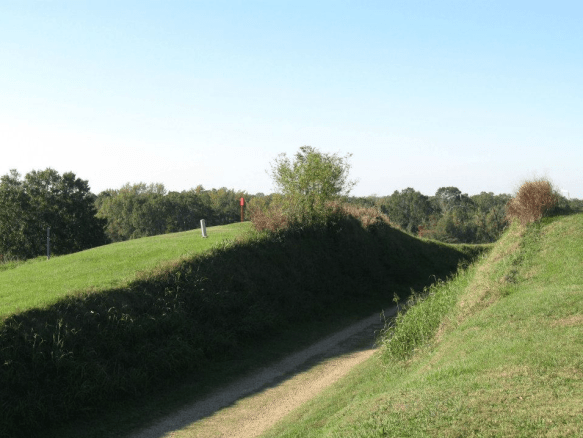
HIKE IT!: There is a 1.5 mile trail called the Big Fill Loop Trail. It provides a beautiful view of the Promontory Mountains, the Great Salt Lake, and the Wasatch Front. Visitors can walk along the original grades of the Central Pacific and Union Pacific railroads and still see drill marks from the tools used to create the tracks.
Imagine yourself in some open grasslands…the weather is humid and rainy. You can see that there’s a lush, beautiful forest nearby and in the river, there are large, expansive, trees growing in and around the river bottoms. The land is verdant and green. You’re actually standing in a flood plain. There are animals like wooly mammoth and giant bison roaming the area. This is the supercontinent Pangaea during the Late Triassic Epoch, over 225 million years ago. What we now recognize as the southwestern part of the United States.
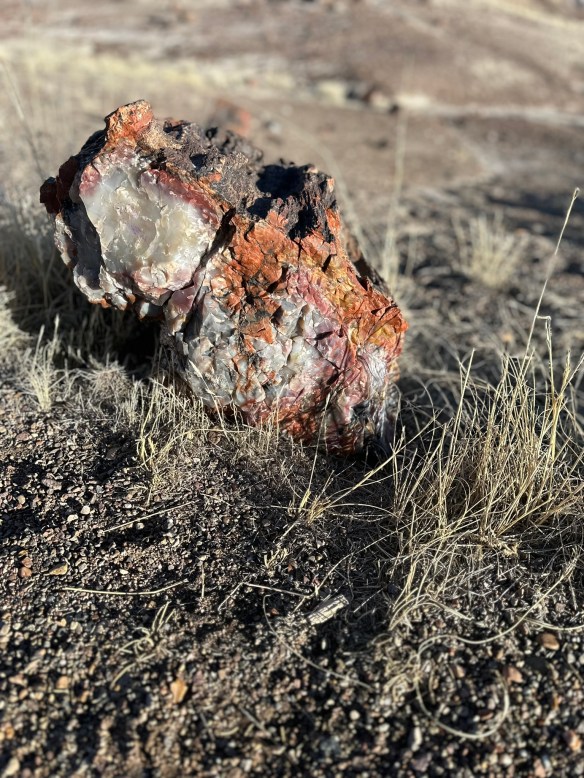
Photo by S. Resendez
Over millions of years, as the continents moved, the land tilted and uplifted, and the climate changed significantly, transforming the environment from a tropical basin to an arid plateau. The trees in that forest eventually fell and became buried in the biorich sediment where mineral-rich water replaced the tree’s organic structure with minerals, and turned them into petrified logs. The gradual uplifting of the land (starting about 60 million years ago) created stress that caused the brittle, crystal-filled logs to fracture like glass rods, creating the segmented appearance. Continual erosion from wind and water eventually exposed the fossils and sculpted the surrounding badlands and colorful Painted Desert formations, revealing the landscape we see today.
The Paleoindian people lived in, and around, the area of the petrified forest and as the climate and environment changed, began to settle the area as evidenced by the pithouses that were built into the land to mark the need for more permanent housing. By this time, the geographical area resembled what we recognize today as the Southwest. By the 1500’s, Spanish explorers began making inroads in search of routes along the Rio Grande and the Pacific Coast. After becoming a part of the U.S. territories in the 1800’s, the army continued to seek routes to the Pacific coastline and in doing so, came across what would eventually become the Petrified Forest National Park.
The Petrified Forest is located within the greater Painted Desert. A variety of animals call this area of the U.S. home, including amphibians such as salamanders and toads; birds; insects; mammals such as fox, coyote, deer, and rabbits; and reptiles like lizards, skinks, horned toads, and snakes. There are also several hundred species of plants and trees throughout the park. Research and dig sites are a constant in the Petrified Forest as scientists continue to learn and provide scientific information about the park to park visitors. This park is best known for its Triassic fossils.
Petrified Forest National Park is open year round except for Thanksgiving and Christmas. Painted Desert Visitor Center and Rainbow Forest Museum & Visitor Center hours are from 8am to 5pm and the Painted Desert Inn National Historic Landmark Hours are from 9am to 4pm. Note: Arizona does not observe Daylight Saving Time, remaining on Mountain Standard Time year-round. For example, in the summer months, during Daylight Saving Time, the time in Arizona and California is the same, with New Mexico and the Navajo Reservation one hour ahead. As usual, always make sure you check ahead in regards to weather and possible closures. This is a pet friendly park!!! Dogs (on leash) are allowed on the trails and there’s even a dog park available. Stop by one of the Visitor Centers and get a BARK Ranger certificate for your furry friend!
Photo by S. Resendez
You can drive through the park in about an hour BUT there are plenty of short hikes that will allow you to see ancient villages, petroglyphs, giant logs, and petrified wood. This is the perfect park to see a lot with minimal physical investment.
MILE MARKER: Did you know Petrified Forest protects one of the richest Triassic fossil sites on Earth—not just fossilized trees, but early dinosaurs and evidence of some of the planet’s oldest wildfires? This park is far more alive than it looks!
HIKE IT!: There are several hiking trails of short to medium length available to hike in the Petrified Forest. The website’s trails page does a fantastic job of describing the trails and in giving you excellent insight into grades, cross slopes, and trial widths. Click on the link for the details.
Glacier Bay National Park and Preserve is more than a stunning wilderness—it’s a living story of ice, culture, and resilience. Once completely covered by massive glaciers, this area is still reshaping itself, revealing dramatic fjords and thriving ecosystems. Home to Tlingit heritage sites, soaring mountains, and wildlife from bears to humpback whales, Glacier Bay invites you to explore its past while experiencing its raw, untamed beauty.
Photo by S. Resendez
The time when the gradual shifting of glaciers began is now referred to as “The Little Ice Age”. It lasted for approximately 550 years and in addition to the extreme cold, there were periods of extreme climate fluctuation that made it difficult for any human beings to survive and thrive. Food scarcity and famine, disease and unrest, plagued the native populations and for at least the last 100 years into the late 1800’s and early 1900’s, the Tlingit people were forced to gradually move off their ancestral lands.
But the shifting of the glaciers also brought out the mysteries of the land and suddenly, a new ecosystem was created which brought attention to the area in and around what we now call Glacier Bay. In 1925, when Glacier Bay became a National Monument, the land in and around Glacier Bay was the ancestral home to the four clans of the Huna (Hoonah) Łingít. In its attempt to preserve and conserve the natural beauty at Glacier Bay, the National Park Service (NPS) fostered new federal laws that severely impacted the lives of the indigenous people. Where they were once free to hunt, fish, and forage the land, new restrictions now curtailed, if not outright prohibited, the Huna Łingít’s ability to live freely on land that was once an integral part of their everyday lives.
Photo by S. Resendez
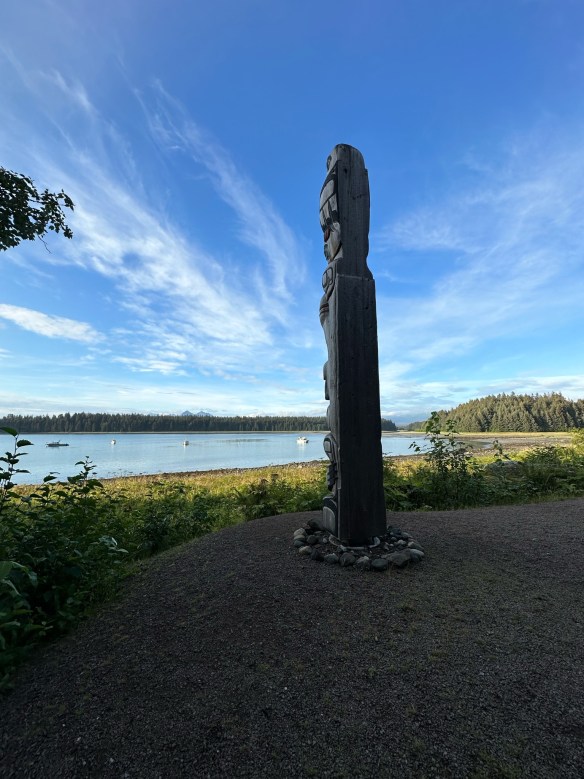
In December of 1980, President Jimmy Carter signed the Alaska National Interest Lands Conservation Act that created Glacier Bay National Park and Preserve. After becoming a national park, the National Park Service and Hoonah Indian Association, began working together to reestablish and reinvigorate traditional and cultural activities. There remains a concerted effort to collect and preserve oral history amongst the Hoonah. And on the shores of Bartlett Cove, a cooperative venture led to the first tribal house to honor the Glacier Bay since Łingít villages were destroyed by the moving glacier 250 years ago. The Huna Ancestor’s House is open to park visitors and provides opportunities to learn about Huna Łingít history, culture, and their ancestral way of life.
Accessibility: Bartlett Cove has a few short trails, a public dock, campground, Glacier Bay Lodge with the Park Visitor Center on the second level, and the Visitor Information Station. These pathsare not paved, and may have exposed roots and rocks. The Tlingit Trail provides a wheelchair accessible gravel path between the public dock parking area and the front of the Huna Tribal House. While navigable by many new wheelchairs, not all trails meet ADA standards. There is also a beautiful wooden boardwalk that provides access to a viewing deck overlooking a serene pond. This 1/2-mile section of the Forest Trail is accessible and easy to negotiate. For more detailed information about accessibility, visit the Glacier Bay National Park and Preserve website.
MILE MARKER: When Captain George Vancouver sailed by in 1794, he didn’t discover Glacier Bay as we know it — because it was completely covered by ice. A single glacier more than 100 miles long and 4,000 feet thick filled the entire bay. By the late 1800s, the ice had already retreated over 30 miles, revealing the stunning fjords and waterways we see today.
HIKE IT!:Several hiking trails are available to hike during your visit to Glacier Bay. You can view, or print, Bartlett Cove Trails Map for a simple visual of the shorter hiking trails. You can also visit the hiking page at the Glacier Bay NPS site. The best known hike at Glacier Bay would probably be the Forest Trail. It’s a 1 mile loop trail that’s rated as easy. The terrain is mostly flat and trail surface varies between dirt, gravel and boardwalk. There are benches and viewing platforms so factor in time to have a seat and enjoy nature. There is also a ranger led guided walk along this trail every afternoon.
There are signs that approximately 10,000-12,000 years ago, in the area we now recognize as the central Texas hill country, the Paleoindian people were utilizing the natural resources of the area to create tools for hunting megafauna such as bison and wooly mammoth. The grasslands of central Texas were the perfect environment for these animals. Add abundant water and flint, or as the Spaniards called it, pedernal, used to create those tools for hunting, and we can see why the area was such a draw for the indigenous people.
Fast forward to the 16th century, Spanish explorers and missionaries are making their foray inland towards central Texas. Lipan Apache are roaming the area and the Franciscans in charge of the missions in San Antonio are suggesting that a mission may need to be built in this part of Texas, as well. While that suggestion never comes to fruition, the influence of the Spaniards is cemented on the land. While in the area, the Spanish explorers begin to refer to the flowing water as the Pedernales River, due to the abundant amount of flint, or pedernal, in the riverbed.
After Texas became a state in 1845, small farming communities began to develop. and in the late 1800’s, the area in and around Pedernales Falls grew, but by the 1930’s, that same area began a decline. Lack of population growth, a depressed economy, and drought, probably helped to diminish and keep the local citizens to the bare minimum. The surrounding land was used for grazing until the original owner sold the land to Charles (C.A.) and Harriet Wheatley.
Photo by S. Resendez
The Wheatley’s named their new ranch, the Circle Bar Ranch and began improvement projects. They built a road that connected their ranch to the nearest county road and began building their home. They brought in purebred Hereford cattle and eventually, steer and goats. Although the Wheatley’s enjoyed hunting, they strongly believed that natural resources should be preserved and protected for the enjoyment of future generations. The Wheatley’s were prolific conservationists. Charles Wheatley helped to organize the National Wildlife Management Institute and was one of the founders of the Texas Fish and Game Commission. He was a friend of Governor Neff, who was responsible for creating the Texas State Parks system. Harriet Wheatley was also a lover of nature who enjoyed hunting and was active in the San Antonio Conservation Society, the Bexar County Girl Scouts, and the Blue Bird Auxiliary. She and Charles were both known to be expert fly fishermen and she even published a book entitled, Lady Angler: Fishing Hunting, and Camping in the Wilderness Areas of America.
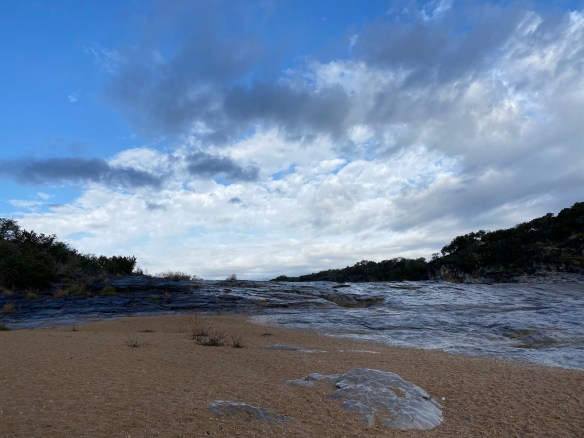
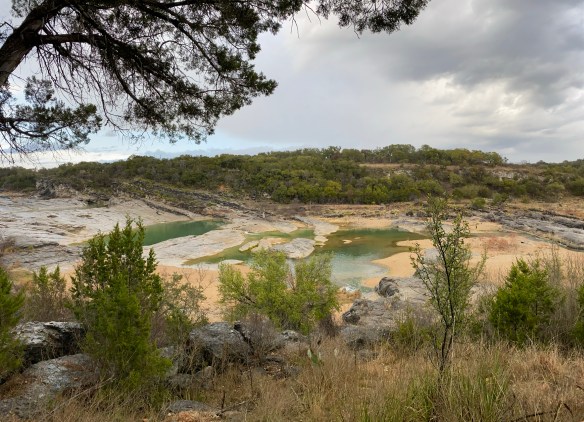
In 1969, Harriet Wheatley sold the ranch to the state of Texas with her wish that “that it be conserved, and all of the wildlife be taken care of, and that it be enjoyed from generation to generation.” The park officially opened in 1971 as Pedernales Falls State Park. The park’s terrain typifies the Edwards Plateau, with woodlands, cedar brakes, grasslands, and lush riparian zones lining the Pedernales River.
The Pedernales Falls State Park is located at 2585 Park Road 6026, Johnson City, TX 78636. The park is open daily open daily and the office is open 8 a.m. to 4:30 p.m. The park’s phone number is (512) 389-8900.
Accessibility: Call ahead for specific information regarding building accessibility. They do have an all-terrain wheelchair available for use in the park. Contact the park to reserve it for your visit.
MILE MARKER: Beneath the falls and limestone shelves, the riverbed preserves fossilized tracks of ancient creatures. If you look closely in certain areas, you can spot impressions of prehistoric marine life that lived here when the Hill Country was covered by a shallow sea more than 100 million years ago.
HIKE IT!: Ten trails, from easy to challenging, are available for hiking, biking, and horseback riding. Trails vary in length from half mile to ten miles mean there are trails for every type of hiker! For more detailed information about the types of trails, check out the hiking trails page on the Pedernales State Park website.
View of the Shenandoah River from the Murphy-Chambers Farm Overlook.
Photo courtesy of NPS/Autumn Cook
Near the area where the Potomac and Shenandoah rivers meet, a group of nineteen men, led by Captain John Brown, invaded the arsenal at Harpers Ferry. The group then took several of the residents of the surrounding neighborhood as prisoners, while emancipating several slaves, and held off United States troops, under the command of Colonel Robert E. Lee, for almost 30 hours, before finally being captured, wounded, or killed. Captain John Brown was captured, tried, convicted, and executed for high treason and inciting slaves to insurrection. While this endeavor appears to have been a failure, the actions of the Captain and the men who accompanied him helped to launch the United States into the Civil War.
Captain John Brown
Photo by S. Resendez
Because Harpers Ferry was chosen by George Washington to be the location of the 2nd national armory in the US at that time, Harpers Ferry was a prime spot for a faction to seize control. Between 1861 and 1865, the town of Harpers Ferry changed hands eight times. Strategically located at the confluence of two rivers and two railway lines, the arsenal at Harpers Ferry and its strategic location made it a hotbed of invasion and occupation that continued throughout the Civil War. In October of 1867, after the Civil War, Storer College was founded. It became the first higher education institution in West Virginia open to African Americans.
From 1909-1968, John Brown Fort stood on the site of Storer College on Camp Hill in Harpers Ferry. In this circa 1915 photograph, Storer College students, faculty members, and their families pose in front of the fort during an evening choral session. Year: 1915. Image Credit: Historic Photo Collection, Harpers Ferry NHP.
African American families continue to maintain their deep connections to the area in and around Harpers Ferry and today, more than 250 years after the first family settled the area, Jefferson County still boasts the longest established African American community in the state of Virginia.
In 1944, Harpers Ferry National Monument was authorized by Congress and in 1963, the park was renamed Harpers Ferry National Historical Park. Today, Harpers Ferry is not only a significant historical site, it also boasts a wide and varied ecosystem that encompasses a deciduous forest, flood plains, mountains, rivers, streams, wetlands, marshes, and swamps. “The park is home to approximately 14 amphibian,18 reptile, 36 mammal, 30 spider, 43 fish, 174 bird, and 276 insect species.”
Harpers Ferry National Historical Park is open year round with the exception of Thanksgiving Day, December 25, and January 1. The Visitor Center is located at 171 Shoreline Drive, Harpers Ferry, WV 25425 and is open daily from 9a to 5p. Shuttle buses run every day the park is open, every 10-15 minutes. Park museums/exhibits and restrooms in the historic Lower Town are open daily from 9 a to 5 p. Hours change seasonally so make sure you visit the website or call for the most up to date information.
Accessibility: The park has two wheelchairs available that may be borrowed by visitors upon request. The park’s shuttle buses are equipped for those with physical limitations. The buses kneel and have lifts to accommodate those who are unable to utilize the stairs. For more details on accessibility for physical, hearing loss, low vision/blindness, please check the website.
MILE MARKER: Harpers Ferry is an anchor point on the Lewis & Clark National Historical Trail. It served as the starting point for the Corps of Discovery’s journey westward on the Lewis & Clark Expedition in 1803.
HIKE IT!: There are several trails with varying levels of length and difficulty ranging from 1 mile to 6.5 miles long. Be sure to check out the hiking page of the Harpers Ferry NPS website for detailed information on the hikes and the Appalachian Trail!
Loudoun Heights Trail in the fall
Photo courtesy NPS / Volunteer Devin Taggart
We’re covering new ground today as this is our first time exploring an NPS National Historic Trail. Based on the NPS definition of what denotes a National Historic Trail, we learn that a National Historic Trail is a “long-distance route that follows and commemorates a historic path of travel that changed the history and character of the U.S.” Today these routes offer opportunities to visit surviving sites, trail segments, and defining places of history as we learn about the diverse stories they tell. According to the NPS site, there are currently 19 trails that range from 16 miles long to a little over 5,000 miles long. For more information about all the trails, click on the link here.
Map courtesy of NPS
Beginning in Mexico City and winding its way through Texas and up into Louisiana, the Camino Real de Los Tejas covers approximately 2,600 miles. This isn’t a “hikeable” trail by definition, rather it should be considered as a chance to follow the historical footsteps of the people who traveled across countries and through inhospitable lands to begin settling the areas we now recognize as Texas and Louisiana.
Spanish Missions in Texas
Photo by M. Gonzalez
Because we’re writing this from our home base in San Antonio, it’s easy to talk about where the trail leads us from here, but before it got to San Antonio, the trail meandered up from Coahuila, Mexico, near the Rio Grande, to Laredo, Texas, in and around Goliad, Texas (where the Camino Real de Los Tejas museum is located), and up through Victoria and Cuero. From here, the trail veers back towards San Antonio, or continues on to Bryan, Texas. There are also documented starting points, once the border was crossed, in Eagle Pass up to San Antonio. From San Antonio, the road continued on through New Braunfels (which later became a German settlement), up to San Marcos, to Austin or towards Bastrop (home of the Lost Piney Woods). From there, the branches seemed to gather near Crockett and continue on towards Nacogdoches and on towards Louisiana. The Camino Real de Los Tejas split or combined according to the seasons. If the weather affected the planned route, the way could be rerouted to avoid flooded areas or other hazards along the way.
There are several missions along this corridor, some missions having been moved from other areas closer to the Gulf of Mexico, and rebuilt to follow the San Antonio River, going east towards Louisiana or west towards California. In this part of Texas, the most famous missions in and around this area are, arguably, the San Antonio Missions National Historical Park, a UNESCO World Heritage site. However, other missions pepper the way along the Camino Real, such as Mission Nuestra Señora del Espíritu Santo de Zúñiga in Goliad State Park.
Mission Nuestra Señora del Espíritu Santo de Zúñiga
Photo by M. Gonzalez
This amazing spot along the Camino Real showcases the work of the CCC (Civilian Conservation Corp) which was instrumental in building, conserving, and restoring a variety of buildings in and around Texas. While Mission Espiritu Santo was established in the mid-1700’s, it was the fourth mission with the same name and after several relocations, found its final home in the area known as La Bahía, which later became known as Goliad, Texas. As time passed and the mission was no longer needed, Franciscan Priests finally closed this mission in 1830.
Between 1933-1942, the men of the CCC followed the plans to meticulously reconstruct the mission under the direction of a young architect by the name of Raiford Stripling. But before they would begin their project, they had to work on a “beginner” project in order to ensure that everyone understood the methods used to build the original mission in the 1700’s. In order to practice, they set about making a cottage for the park’s “superintendent to be”. In building this cottage, the men of the CCC could practice their brick making skills, along with learning to work with native materials, and making latilla ceilings (a traditional Southwestern design element consisting of peeled branches or small pieces of wood (latillas) laid between beams (vigas) to create a rustic, decorative ceiling). They learned how to hand carve large, ornate doors and forge iron hinges and once the cottage was finished, they understood what needed to be done to recreate the actual Mission de Espiritu Santo.
Latillas and Vigas
Photo by M. Gonzalez
The Mission Nuestra Señora del Espíritu Santo de Zúñiga is the highlight of Goliad State Park and rightfully so. This mission, reconstructed on top of the its original 1749 foundation and wall remnants, is a testament to architecture and history as we make our way along the Camino Real de Los Tejas on the way to Louisiana.
If you’re interested in learning more about the Royal Road or following in the path of long ago Spanish settlers, look here for a FREE downloadable checklist of places to visit along the Camino Real de Los Tejas.
But there’s more to Goliad, Texas than meets the eye! We’re not done with our stop here just yet because in the midst of traveling this royal road through history, we also find ourselves in the heat of the battle for Texas independence! We’re going to look at, and talk about, flags you might not have known even existed! Stay with the Two Chicks for more adventures in Goliad, Texas!
MILE MARKER: A staircase, carved from two logs, could be placed in tight spaces that might have otherwise only had room for a ladder. Known as “Escaleras de Madera” or Staircases of Wood, they were also sometimes referred to as “Witches Staircases” as folklore denotes the stairs were designed to prevent witches from climbing them.
Escalera de Madera
Photo by M. Gonzalez
HIKE IT!: There is a paved trail that runs through the park and connects the Presidio La Bahía to Goliad State Park and continues on towards downtown Goliad. Within the park, there is a trail that follows alongside the San Antonio River. It’s easy to park in the parking lot at the state park and walk the trail which is relatively flat and accessible. There are also hiking trails at the Medina Valley Natural Area. This area, just south of San Antonio, was part of the Camino Real de Los Tejas and there are some lovely trails to hike along the Medina River.
Deep in the high desert of New Mexico, there sits a 367 foot high, sandstone mesa known as Acoma Rock. This is home to Acoma Sky City Pueblo. The ancient Puebloan tribes began to inhabit this mesa, and the surrounding area, as far back as 1150 AD. It is believed that the Puebloans originally inhabited the desert area in and around the mesa until eventually, they found a way to get to the top of the mesa by building crude steps, including hand holds and toe holds, which allowed people to climb up the side of the mesa. Once there, they more than likely realized that its high, isolated location made it virtually impossible to penetrate.
The ancient Puebloans were potters, artisans and architects. The pueblo was a village of roughly 500 three or four stories tall adobe houses. Dwellings were built on the mesa, not unlike those in Mesa Verde, except that the dwellings were not built into cliffs, but on them. People entered buildings via ladders placed through holes in the roof. If materials had to be brought up from the desert or surrounding area, people had to carry everything to construct the buildings up the cliffs on their backs.
Ladder to other worlds
Photo by M. Gonzalez
During the times when the Spanish began their explorations and making their presence known, the Acoma people were able to generally refrain from contact due to their location atop the mesa. When the Spaniards finally made their way to the top of the mesa where the dwellings were located, initial contact was friendly, but over time, as Spanish demands for food and supplies increased, tensions rose. The Acoma people retaliated and months later, the Spanish responded in force, killing over 1500 people. Many survivors were mutilated and forced into slavery and eventually surrendered the pueblo to the Spanish. This lead to the rebuilding of the pueblo under Spanish rule.
San Estévan del Rey Mission Church of Acoma
Photo by M. Gonzalez
Missionaries began their efforts to convert the people to Catholicism and to force them to give up their way of life. The Mission San Estevan del Rey church was built on the mesa in an effort to move the religious agenda forward. The church itself is an amazing structure, especially when you see it for what it is…a place where the people of Acoma could create a flux between Catholicism and their own culture. This is how the church is utilized today. The ceremonies of the people of Acoma are practiced inside the church and the church stands as a testament to the tenacity of the Acoma people and their culture. It is a large, beautiful building consisting of materials that had to be carried up the cliffs on the backs of the enslaved people forced to build it. The roof is held in place by 40-foot long Ponderosa pine vigas, or roof beams, originally hewn in the San Mateo Mountains, 30 miles away. The vigas were carried in by the enslaved people and were not allowed to touch the ground throughout the journey back to the mesa. There is a simple cemetery in front of the church and all the earth used to create that cemetery also had to be brought up the side of the mesa.
Acoma Pueblo
Photo by M. Gonzalez
Acoma was designated a National Historic Landmark in 1960. In 1970, it was placed on the National Register of Historic Places and in 2007, the San Estévan del Rey Mission Church was designated a National Trust Historic Site. It is the only Native American site with that designation. The pueblo consists of approximately 250 dwellings that have held to tradition and currently have no electricity, sewer, or running water. The pueblo is largely uninhabited but there are some families who choose to live there year round. The pueblo is usually filled to capacity during feasts, dances, and community gatherings.
Cultural Center
Photo by M. Gonzalez
Sky City Cultural Center is located approximately 50 miles west on I-40, then another 12 miles on State Route 23. Signs are easily visible once you exit the interstate. The cultural center is open Monday and Tuesday 9am- 4pm and Wednesday- Sunday 9am- 5pm. Monday & Tuesday tour times are 10:30am, 12:30pm, and 2:30pm. Wednesday- Sunday tours start every hour starting at 9:30am to 3:30pm. There are annual closures, and sometimes there are unannounced cultural events that require closure. Weather issues may affect tour times. You can check the website for more details or all 800-747-0181 between 9am to 5pm for specific questions prior to your visit. The price for a tour is approximately $30 at the time of this posting so it may have changed depending on when you’re reading this post. Entry fee includes your photo permit. Your photo permit allows you to take pictures of the pueblo except for inside the Church, within the cemetery courtyard, and during feast days. Permission must be obtained prior to photographing tribal members or their artwork.
Use of tripods, GoPros, video cameras, digital video cameras, binoculars and audio recording devices is prohibited. Commercial use of a photograph depicting Acoma imagery for personal gain (profit) is prohibited. For more information on guidelines, click here.
MILE MARKER: “Acoma is on the Zuni-Acoma Trail, an ancient footpath connecting the old Zuni and Acoma Pueblos. Once used by both native peoples and Spanish explorers, the seven and a half mile-long trail is enjoyed by hikers through New Mexico’s beautiful lava beds. The Zuni-Acoma Trail is part of the El Malpais National Monument, which the National Park Service manages.”~Information courtesy of NPS
Hiking down the mesa
Photo by M. Gonzalez
HIKE IT!: There aren’t any specific trails on the mesa itself, but the guided tour takes about an hour and a half and I logged about one and half miles by the time the tour was finished. If you want to add a bit more adventure to your day, you will be given the option, towards the end of the tour, to take the steps down the side of the cliff and walk back to the Cultural Center. If you’re going there in the summer, be prepared for intense heat. Water and restrooms are only available at the visitor center so bring a hat, wear some sunscreen, and bring some water. Walking sticks help because the terrain in the pueblo is uneven.
Ahhhhh…do you like it steamy?! If so, have we got a place for you!
Photo by S. Resendez
Indigenous people have been quarrying stone from this area of Arkansas for thousands of years. After an exploration expedition in 1804, sent by President Thomas Jefferson, the hot springs were discovered and shortly afterwards, Europeans arrived and began utilizing the geothermal springs. There was talk that the spring waters had healing abilities. A town grew in the area of the springs that later became known as Hot Springs. The resulting bathing industry was built around the geothermal springs coming from the Hot Springs Mountain. This later became known as the “American Spa”.
In 1832, President Andrew Jackson signed legislation to preserve “…four sections of land including said (hot) springs, reserved for the future disposal of the United States (which) shall not be entered, located, or appropriated, for any other purpose whatsoever.” This proclamation meant that Hot Springs National Park was actually the very first, and now the oldest, national park in the current national park sites. Unfortunately, there was no accompanying legislation that prohibited building or settling in or around the area, which meant that people continued to build around and over the springs.
Ozark Bathhouse
Photo by S. Resendez
Victorian bath houses built between 1880-1888 were considered large and luxurious, but by the early 1900’s, they were eventually replaced with fire-resistant brick and stucco. This was a precaution due to a severe fire in 1878 which decimated south and central downtown Hot Springs. In contrast to the previous structures, these newly built bath houses featured marble walls, billiard rooms, and gymnasiums. The culmination of changes to Bathhouse Row was completed when the Lamar Bathhouse opened its doors for business in 1923. These bathhouses are all still standing today.
After the Civil War reconstruction era, African Americans found that they could work at the bath houses but they still could not receive services from the bathhouses so they built and maintained many of their own bath houses. African American bathhouse attendants were an integral part of the bathing industry in Hot Springs. They organized to protect their pay and professions from exploitation. And in the early 1900’s, African American residents built the first bathhouse used exclusively by African Americans. For a more in depth look at how African Americans impacted the bathing industry at Hot Springs, visit the NPS link about Bathhouse Attendants at Hot Springs National Park.
The Grand Promenade
Photo by S. Resendez
Take a short walk along the Grand Promenade. This walk runs behind the eight bathhouse buildings that were built between the years 1892-1923. Most of these buildings are open to the public with Fordyce functioning as the park’s visitor center. They can be accessed from Central Avenue. The Fordyce Bathhouse is open every day from 9:00-5:00pm, with the exception of Thanksgiving Day, Christmas Day, and New Years Day.
Today, there are only two bath houses where you are permitted to soak in the springs: the Buckstaff and the Quapaw. There are no entrance fees for the park but because this park encircles a city, you will probably have to pay for parking somewhere in the general area. This is one of the national parks that allows pets! Pets are welcome in the park and on the trails but not in the federal buildings. There is a cell phone tour available for Bathhouse Row so you can stop and listen along the way. If you decide to visit in the summer months, be prepared for the heat! Drink lots of water and wear a hat!
Accessibility: The Fordyce Visitor Center, Gulpha Gorge Campground, other park buildings, and all park bathrooms have functional ramps and are accessible to all persons. Bathhouse Row is paved and has a four to five foot wide walkway that creates a circular loop around the block. There are benches with backs along the Grand Promenade if you need to sit down and rest. There are two wheelchairs available to loan free of charge for use in the Fordyce Bathhouse Visitor Center and Museum. There are tactile exhibits along with self-guided tour books in braille as well as audio descriptions some exhibits and the park films. ASL interpreters are available for guided tours, but you must submit a request two weeks in advance. There are two accessible trails in the park. The Grand Promenade is a half-mile (one-way), fully paved trail with ramp access off Fountain Street and another behind the Fordyce Bathhouse. Whittington Park Trail is a 1.2 mile gravel trail that is a flat but unpaved loop.
MILE MARKER: The water in the hot springs is over 4000 years old! The thermal water that bubbles up in the park today fell as rain over 4,000 years ago. It percolates deep underground, gets heated by the earth’s geothermal energy, and reemerges through the Hot Springs Fault. So when you step into those bathhouses, you’re literally soaking in ancient rainwater!
HIKE IT!: There are over 20 miles of hiking trails in and around the Hot Springs National Park! Levels vary but there are plenty of options for anyone looking to get out of the city and into nature. Paper trail maps can be obtained at the Fordyce Bathhouse and Visitor Center and digital maps with real-time GPS location are available by downloading the service-wide NPS App. Make sure you check at the visitor center before starting your hike just in case there have been any updates or closures.
There are signs that in around 1849, Mescalero Apache watered their horses at the Mescalero Springs. Later, Mexican farmers dug canals by hand to irrigate their crops, which they later sold to people who lived in Fort Davis. The farmers called these springs the San Solomon Springs. In 1927, the springs were dredged and a canal was built to better utilize the flow of the water. Records show that the springs around Balmorhea have been in use for almost 11,000 years.
San Solomon Springs Motor Courts Photo by S. Resendez
In 1934, the State Board of Texas acquired approximately 46 acres around the San Solomon Springs. The Civilian Conservation Corp (CCC) arrived at the springs in July 1934 and began work on building what would later become Balmorhea State Park. The CCC created the 1.3 acre pool around the springs. They also built the concession building, the bath houses, and the motel court using native limestone and hand hewn adobe bricks.
Balmorhea Swimming Pool
Photo by S. Resendez
The San Solomon Springs is the largest in a series of 6 springs located in the Chihuahuan desert. The Balmorhea State Park Swimming Pool is the world’s largest spring-fed pool and often referred to as the crown jewel of the Texas State Parks System. The springs originally emptied into what is known as a ciénga or desert wetland. Construction of the swimming pool, back in 1934, resulted in the destruction of the natural springs which were rebuilt and fashioned into two man-made ciéngas.
Ciénega
Photo by M. Gonzalez
There is an overlook by the RV section of the park for visitors to look for wildlife like deer, javelina, squirrels, turtles, lizards and dragonflies, which also utilize the springs. San Solomon Springs also serves as a stop for resident and migratory birds and is home to several rare and endangered species of snails and fish. San Solomon Springs is the largest spring in the Balmorhea area, and the habitat at Balmorhea State Park is very important for the conservation of these species.
Balmorhea State Park is located at 9207 TX-17, Toyahvale, TX 79786. Daily entrance fee for adults is $7 and free for children 12 and under. Park hours are from 8a to 7:30p or sunset (whichever comes first) and office hours are from 8a-5p. They often reach capacity and highly recommend reservations for both camping and day use. You can reserve passes online or by calling the customer service center before you visit. Check the park’s Facebook page for updates. Read their FAQ page for more detailed information about park and pool rules. Make sure you plan your visit before going!
Chihuahuan Desert Nature Center Entrance Photo by S. Resendez
About 41 miles south and just outside of Fort Davis, Texas, sits the Chihuahuan Desert Nature Center. The Chihuahuan Desert Research Institute (CDRI) is a nonprofit organization that was established in 1973 and housed in Alpine, Texas. Its principal founders were science professors at Sul Ross State University, a university that the institute continues to work closely with today. Today, the CDRI is the Chihuahuan Desert Nature Center and is located on 507 acres in the foothills of the Davis Mountains.
Susan intently studying the locations of the mines!
Photo by M. Gonzalez
The Nature Center is open year round. If you’re interested in exhibits about geology, history, and culture of the Chihuahuan desert, there is a mining exhibit detailing desert mining and the geological changes that have occurred in the Trans-Pecos of Texas over the last 2 billion years! A bird blind is available for birders, and there’s a cactus museum which houses over 200 species, sub-species, and varieties of cacti and succulents.
Photo by M. GonzalezPhoto by M. GonzalezPhoto by S. Resendez
If you don’t feel like hiking, there are botanical gardens which encompass a wildscape garden, a self-guided stroll through a Trans Pecos Natives garden, a pollinator garden trail, and a native grasses exhibit.
Check the website for Chihuahuan Desert Nature Center before heading out. The Center is located off of Hwy 118, 4 miles SE of Fort Davis at 43869 St. Hwy. 118, Their hours are Monday-Saturday, 9a-5p.
MILE MARKER: Would you believe that cactus can be found as far north as Canada?! Some species have evolved to withstand cold temperatures and dry conditions. Southern prairies and certain regions by the Great Lakes, provide habitats with enough sun, well-drained soil, and suitable temperatures for cacti to thrive.
HIKE IT!: There are lots of great hiking trails at the Chihuahuan Desert Nature Center. There are 5 trails ranging from .25 mile (scenic loop inside the botanical garden) to a 2.5 mile loop, which is considered a strenuous hike. Remember, you are hiking at an elevation of approximately 5,000 feet! Consider the weather and your own physical abilities. While the trails are mostly earthen, they may be uneven so take your hiking sticks, sunscreen, a good hat to cover your head and face, and plenty of water. After all, you’re desert hiking!
Trail Map for CDNC
Photo courtesy of Chihuahuan Desert Nature Center
Minidoka, one of ten incarceration sites established during World War II, stands as a powerful reminder of the injustices faced by Japanese Americans forcibly removed from their homes during the onset of World War II.
In the 1880’s, Japanese immigrants began making their way to America, primarily to Hawai’i, where they worked in the sugar plantations. From there, many Japanese immigrants made their way to the mainland where they worked clearing mines, building the railroad, at sawmills, and in the fields. This was due in part to The Chinese Exclusion Act of 1882, which was the first significant law prohibiting immigration of Chinese laborers for 10 years.
By the early 1900’s, Japanese families had assimilated into American culture. With a strong presence in Hawai’i and along the entire west coast of the United States, Japanese American families were fully productive members of society. They were business owners, educators, entrepreneurs, and neighbors. Despite lingering racist sentiment, much of it stemming from the Asian Exclusion Act of 1924, Japanese-American families had tentatively created a place for themselves in America. Then, on December 7, 1941, Imperial Japan launched an unprovoked attack on Pearl Harbor. The United States declared war with Japan and life for Japanese Americans immediately changed.
Photo by S. Resendez
Predicated by the Asian Exclusion Act of 1924, on February 19, 1942, President Franklin D. Roosevelt signed Executive Order 9066, declaring certain areas within the United States as “war zones” thus enacting the removal of any and all Japanese Americans from their homes, forcing them into imprisonment without the benefit of due process. This remained in effect for the duration of the war. Despite some opposition and varied court cases filed against it, the executive order was not overturned until 1944.
Japanese Americans were first sent to temporary detention facilities, usually animal stables, racetracks, or fair grounds, and were held there until they were transported to their assigned War Relocation Camp. Ten major camps were set up for Japanese-American relocations. Minidoka was just one of them.
Minidoka National Historic Site is located in Jerome, Idaho, in the south-central part, not too far from Twin Falls. The concentration camp sat on approximately 33,000 acres and housed approximately 13,000 people, mostly from Washington, Oregon, and Alaska. The compound consisted of over 600 buildings, including the barracks where families lived. Before families arrived at Minidoka, they were given little to no notice that they had to vacate their homes. They were not allowed to bring anything they could not carry themselves.
Upon arrival at Minidoka, the prisoners learned that the camp was barely able to house all the incoming. Barracks had been hastily built using green wood and tar paper. One young man wrote of getting off the bus and walking into a dust storm. The minimally built shelters did nothing to keep out the elements as the green wood shrank and created gaps for the wind, dust, and rain to get through. There was no privacy in the large, shared buildings, and as an added insult to injury, prisoners were forced into labor, building more of the barracks that would be needed to house the hundreds of people coming in daily. Even the plumbing and sewage system wouldn’t be completed for several months. Across the nation, over 120,000 people were forced to live in these camps, in horrific conditions, with many of them being U.S. citizens,
Photo by S. Resendez
Minidoka consisted of 36 residential blocks with 12 barracks, a mess hall, and a latrine. Each barrack was 120’x 20’, which was divided into six units. Each unit housed a family or a group of individuals. Each unit had one lightbulb and one coal burning stove. The walls dividing the units did not extend to the ceiling and the barracks had no insulation. Bathrooms consisted of a row of toilets and a row of showers. There were no partitions or dividing walls. Each block held a mess hall which served as a “hub” of sorts for families to gather and eat and hold community events like holiday parties or dances.
While not ideal, the families and individuals living within the concentration camp made the best they could of their situation. They educated their children in makeshift schools. They created sports teams, building a baseball field and basketball courts so they could play. They hosted cultural events amongst themselves, held religious services, and even published their own newspaper. The Japanese American people proved to be resourceful as well as resilient.
Baseball Field
Photo by S. Resendez
While in the concentration camps, males were offered the “opportunity” to serve their country as long as they signed acknowledgment and swore “unqualified allegiance” to the US and that they also forswore allegiance to any foreign power, including the Japanese Emperor. Most of the interred men wanted to serve their country but were angry at having to declare their allegiance to a country for which they never gave up their allegiance. How could they renounce allegiance to an emperor they never swore allegiance to in the first place? In the end, the men who decided to answer “no” to the questions regarding their allegiance were removed from the internment camps and sent to high security camps or detention centers. Most of the 30,000 Japanese American men who saw battle became part of 442nd Regimental Combat Team and the 100th Infantry Battalion, with many still who became part of the Company B of the 1800th Engineering Battalion. In all, they were awarded six Distinguished Service Crosses during the first eight weeks of combat and three Presidential Unit Citations. Eventually, joining the 442nd Combat Team and the 100th Infantry Battalion, Company B of the 1800th Engineering Battalion is often recognized as the most decorated American unit for its size and length of service.
“Americans are going to regret the injustices that we may have done.”
Photo by S. Resendez
In late 1944, in the case of Ex parte Mitsuye Endo, the Supreme Court ruled that Executive Order 9066 was unconstitutional. Also being reviewed by the Supreme Court in 1944, was the case Korematsu v. United States. In this case, (which was happening at almost the exact, same time as the Mitsuye Endo case) the use of the internment camps was upheld and is often cited as “one of the worst Supreme Court cases of all times”. In his dissent, Justice Frank Murphy said this,
I dissent, therefore, from this legalization of racism. Racial discrimination in any form and in any degree has no justifiable part whatever in our democratic way of life. It is unattractive in any setting, but it is utterly revolting among a free people who have embraced the principles set forth in the Constitution of the United States. All residents of this nation are kin in some way by blood or culture to a foreign land. Yet they are primarily and necessarily a part of the new and distinct civilization of the United States. They must, accordingly, be treated at all times as the heirs of the American experiment, and as entitled to all the rights and freedoms guaranteed by the Constitution.~~Korematsu v. United States, 323 U.S. 214 (Supreme Court of the United States 1944)
When the camps closed and the prisoners were released, they were given the paltry sum of $25 and a one-way bus or train ticket to the destination of their choice. Despite the fact that the war was over and the despite the fact that Japanese Americans fought for their country alongside other American soldiers, anti-Japanese sentiments made integrating back into their communities difficult.
Life After Minidoka
Photo by S. Resendez
After the war ended, President Truman signed the Japanese American Evacuation Claims Act of 1948. This entitled anyone who was incarcerated to file claims for damages and loss of property but reparations did not come close to the $148 million dollars claimed. Only $37 million dollars had been allocated for damages. After the Civil Rights Movement, reparations were again sought and in 1980, the commission on Wartime Relocation and Incarceration of Civilians was signed into law. They discovered that the incarceration was the result of “racial prejudice, wartime hysteria, and a failure of political leadership.” In 1988, the Civil Liberties Act of 1988 was formalized, with President Ronald Reagan formally acknowledging the unconstitutional nature of the internment camps. Japanese Americans who were wrongfully imprisoned finally received reparations of $20,000 along with a formal apology.
Survivors and family members, friends, and allies of the people who were incarcerated at Minidoka participate in an annual pilgrimage. To learn more about their pilgrimage, click here.
The Minidoka Visitor Center is located at 1428 Hunt Road in Jerome, Idaho. If the visitor center is not open during your visit, you can check the after hours box for brochures. The historic site grounds are open year-round for self-guided walking tours. The Visitor Center is open Friday, Saturday, and Sunday from 10a to 5p. Restrooms are unavailable if the Visitor Center is closed.
The books mentioned in the podcast are Facing the Mountain: A True Story of Japanese American Heroes in World War II by Daniel James Brown and The Train to Crystal City: FDR’s Secret Prisoner Exchange Program and America’s Only Family Internment Camp During World War II by Jan Jarboe Russell
MILE MARKER: Despite the limited rations given at the internment camp, residents created gardens, grew crops, built hog and poultry farms and became completely self-sustainable. They even managed to create their own tofu plants.
HIKE IT!: Minidoka National Historic Site offers 1.6 miles (2.5 km) of gravel walking trails which is basically a self-guided tour of the grounds. It is essentially flat and not difficult to navigate on foot. It is not considered an “accessible” trail. There is plenty to see and read along the route. The sign boards offer stories of information regarding the activities on the land.