When East Met West: A Traveler’s Guide to Golden Spike National Historic Park

Photo by S. Resendez

America was moving west and it wasn’t an easy trek. As settlers began making their way into and across the United States, there was a push to move westward in the 1800’s. Gold had been discovered, Spaniards were making inroads and discovering land and an abundance of natural resources. Places like Fort Davis were providing a safe respite from the wild west but it was taking time for get from one end of the country to the other. Wagon routes and months-long sea voyages were slowing progress. Many leaders—businessmen, politicians, and military planners—began calling for a faster, safer way to connect the nation, a nation dreaming of speed and connection.

But the idea stalled for years because Congress couldn’t agree on where the route should run. Northern states pushed for a northern path; Southern states demanded a southern one. The political deadlock broke only after the Civil War began, when Southern representatives (who preferred a southern route) withdrew from Congress. Suddenly, the northern-backed plan had a clear path forward.

In 1862, President Abraham Lincoln signed the Pacific Railway Act, officially launching the transcontinental railroad. The government supported it with land grants and loans, while two companies—the Union Pacific (building west from Omaha) and the Central Pacific (building east from Sacramento)—took on the construction. Their lines met in 1869 at Promontory Summit, Utah, forever transforming travel, trade, and the American West.

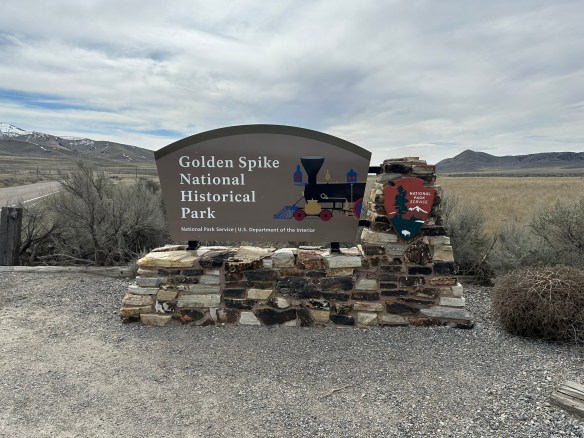
 On May 10, 1869, officials from the Central Pacific Railroad and the Union Pacific Railroad met at PromontorySummit, in Box Elder County, Utah, to drive the final, ceremonial spikes, linking the eastern and western United States by rail. In 1965, the site of the last spike on the transcontinental railroad was designated a National Historic Site. In March of 2019, the park’s designation was changed from a historic site to a historic park, just in time to for the commemoration on May 10, 2019, as America celebrated the 150th anniversary of the completion of the First Transcontinental Railroad and recognizing the historic site as the Golden Spike National Historical Park.

Photo by S. Resendez

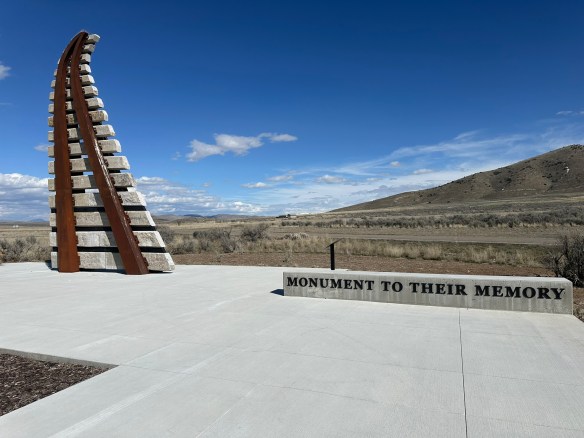
While connecting the railways was indeed a giant leap forward for the United States, it should be noted that these strides were made on the backs of several groups of people. Native Americans were already settled in the west and the construction of the railroad caused the people from 15 tribal nations to watch their homes and livelihood be destroyed with the advancement of the railroad. Irish immigrants, who came seeking work during potato famine in the mid-1800’s, were instrumental in helping build the railroad despite religious discrimination and.a language barrier. And Chinese immigrants, who were reluctantly hired after a critical shortage of labor was created due to gold strikes, were responsible for a great majority of the hardest labor that went into building the transcontinental railway. Chinese workers were often given tasked with working in the most dangerous conditions. Tunnels in the Sierra Nevada Mountains that had to be bored into solid granite for the railroad, rockslides, explosions, exposure, avalanches, and violent clashes claimed the lives of many of the Chinese workers. It is estimated that over one thousand Chinese laborers died building the CPRR. At the 1869 Golden Spike ceremony, not a single Chinese laborer was invited or mentioned, despite their indispensable role.

Central Pacific Railroad Jupiter
Photo courtesy NPS

Today, Golden Spike National Historical Park offers a variety of things to do during your visit. Commemorative events, seasonal events, nature, and hiking are all available at this park. There are approximately 55,000 visitors a year and the visitor’s center is open seasonally, at various hours. Please check the website for specific information before your visit. The physical address is 6200 North 22300 West, Promontory, Utah. It is approximately 30 miles west of Brigham City. The park is 2,735 acres of land surrounding a 15 mile stretch of the original Transcontinental Railroad. There is only one paved road coming in to the visitor’s center.

MILE MARKER: Did you know that the famous golden spike wasn’t hammered into place at all—it was gently tapped, lifted back out, and sent home, while the real work of joining the rails happened quietly behind the scenes.

HIKE IT!: There is a 1.5 mile trail called the Big Fill Loop Trail. It provides a beautiful view of the Promontory Mountains, the Great Salt Lake, and the Wasatch Front. Visitors can walk along the original grades of the Central Pacific and Union Pacific railroads and still see drill marks from the tools used to create the tracks.

Hiking Around an Ancient Volcano: Devils Tower National Monument

Photo by S. Resendez

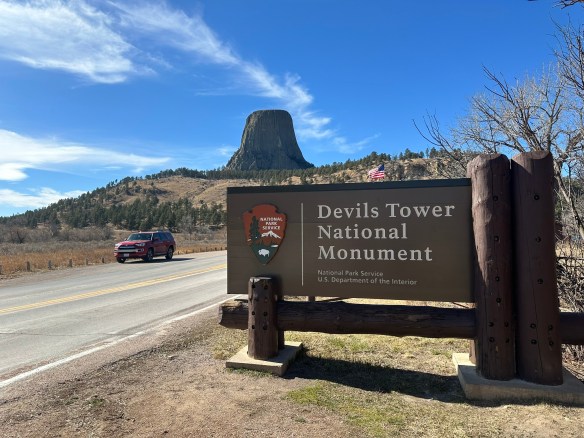
Many people will look at this towering section of striated stone and think to themselves that it looks familiar, even if they’ve never been there. Yes, this is the site made famous in the Steven Spielberg 1977 movie, Close Encounters of the Third Kind. But before it became a focal point of a movie about contact with extraterrestrials, it was famous in its own right. The Devils Tower National Monument, also known as Bear Lodge, was dedicated by President Theodore Roosevelt as America’s first national monument in 1906.

Photo by S. Resendez

There are a multitude of theories surmising how the tower came to be. In reality, all theories agree that the tower did not start out as a tower. In fact, the structure began beneath the earth’s surface and was created from magma that came to be in its current state via erosion. We will probably never know which theory regarding the actual creation is correct due to the fact that the erosion essentially eliminated the evidence to substantiate any theory.

Photo by S. Resendez

Despite questions surrounding its creation, the physical tower is imposing. Devils Tower is 1,267 feet (386 m) tall and sits above the Belle Fourche River. It is the world’s largest example of columnar jointing. It is considered a sacred place for over 20 Native American tribes and ceremonies are still held there. As you walk on the trails, you may come across cloths or small bundles attached to the trees. These are Native American prayer cloths and represent the spiritual connection some tribes have with the Tower. Do not touch, disturb or remove the prayer cloths. Also, it is considered culturally insensitive to photograph these prayer cloths.

Park roads and trails are open 24 hours/day. Visitor Center/Library summer hours are from 9a to 6p. Hours change by season so if you want to see the visitor center, make sure you verify on the website before going. The park usually sees around 500,000 visitors per year; over 80% of whom come between Memorial Day and Labor Day (late May to early September), so plan accordingly.

Parking is very limited. The park often experiences maximum parking capacity for several hours every day throughout the summer (usually between 10a-3p). There is a map and a suggestion to park outside the park and hike into the visitor’s center, if you don’t want to deal with the parking issue.

Accessibility: The Visitor Center is wheelchair accessible and can accommodate wheelchairs up to 35 inches in width. Accessible restrooms are available. While the trail loop is paved, steep grades mean the trail is not recommended for wheelchair users.

Photo by S. Resendez

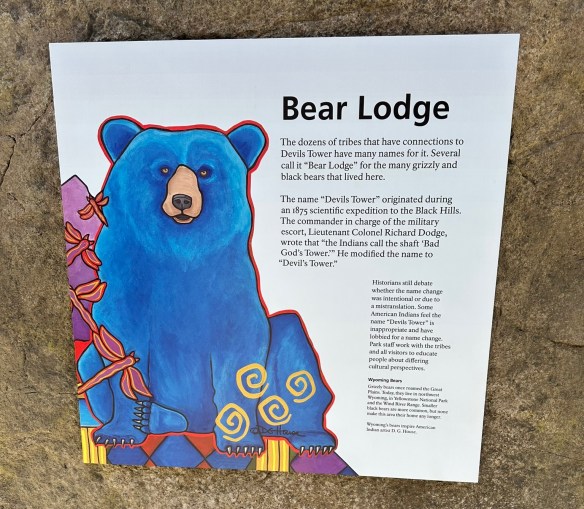
MILE MARKER: The word for devil/evil spirit is Wakansica. It can be translated as “bad god” or “evil spirit”. The Lakota word for black bear is Wahanksica. It is possible that the name Devils Tower, which is called “Bear Lodge” in Lakota, came about due to a mistranslation of “Wahanksica” for “Wakansica”. It is also possible that Colonel Richard Irving Dodge, a man who publicly advocated for the genocide of Native Americans, ascribed the name Devils Tower to this sacred mountain merely to offend and disrespect indigenous tribes. To find out more about the movement to restore the original Native American name of Devils Tower back to Bear Lodge, click here.

HIKE IT!: There are several hiking trails in and around the Devils Tower. The most popular is the Tower Trail but there are plenty of other hiking trails for hikers of different levels to enjoy. The NPS website for Devils Tower does a great job of breaking down the hiking trails based on how much time you think you plan on spending at the park. Make sure you check it out and plan your hike ahead of time!

“Canyon de Chelly: Where Culture, History, and Landscape Meet”

Canyon de Chelly was authorized in 1931, but its roots go back further than our imaginations can carry us.

Initially inhabited by Ancient Puebloans until the mid-1300’s, they were followed by the Hopi, and in the mid-1600’s, the lands were finally settled by the Navajo, also known as the Diné.

The Navajo were able to prosper in the canyons, raising their families, farming crops, planting orchards, and caring for livestock, until the late 1700’s when many external forces created challenges to their ability to live on their rightful land. Invasions by the Ute, other tribes, and Spanish colonists challenged Navajo defenses, which were eventually overrun.

The Navajo built their lands up again, only to be assailed in the 1860’s by Col. Kit Carson of the U.S. Army, who utilized a scorched earth policy to decimate the land and forced the Navajo people to leave their home and walk 300+ miles over a span of 3 years. The Navajo, as well as the Mescalero Apache, were forcibly removed from their homelands and “relocated” to an outpost known as the Bosque Redondo Indian Reservation, which was intended to be a reservation but quickly became a prison camp. Lack of rations, disease, and horrific living conditions resulted in the deaths of approximately 1500 people, not including those who perished during the Long Walk to Bosque Redondo.

In 1868, a treaty was signed acknowledging the sovereignty of the Navajo Nation and the Navajo people were allowed to return to their land. In 1931, President Herbert Hoover authorized the Canyon de Chelly National Monument. Canyon de Chelly covers approximately 84,000 acres, all of which resides fully in the Navajo Nation. There are still at least 40 families residing within the boundaries of the park. The Navajo people and the National Park system share resources and work in tandem to preserve this beautiful monument.

Canyon de Chelly has no entrance fee! There is a Welcome Center with a park store. The entrance gates are open from 8a-5p daily except for Thanksgiving, Christmas and New Year’s Day.

Plan ahead to learn more about the scenic drives. There are two paved, rim drives with several overlooks. The North Rim Overlook offers views of the cliffside dwellings and the South Rim offers more scenic views including a view of Spider Rock.

Each drive takes approximately 2 hours, according to the park website, so plan for a 2-4 hour trip if you plan on making all stops for photo opportunities. The park website provides suggestions for what to see depending on how much time you’ve allotted for your visit.

Primitive campsites are available for a fee. Self-guided hikes and Ranger led programs are available but check before hand for changes in fees and schedules. Private canyon tours are available by hiking, horseback or vehicle. As with other parks and sites where people are currently in residence, please look out for and respect any signs that prohibit taking photographs.

MILE MARKER: The Navajo and Apache people are Athabaskan speakers. They are distantly related to the Athabaskan people from Canada and Alaska.

HIKE IT!: The White House Ruins Trail is a 2.5 mile, round trip hike that descends 600 feet into the canyon. This is the only self-guided tour at Canyon de Chelly and although it is currently closed, there are plans to reopen the trail sometime in 2025.

Check ahead on the website before making plans.