Ahhhhh…do you like it steamy?! If so, have we got a place for you!
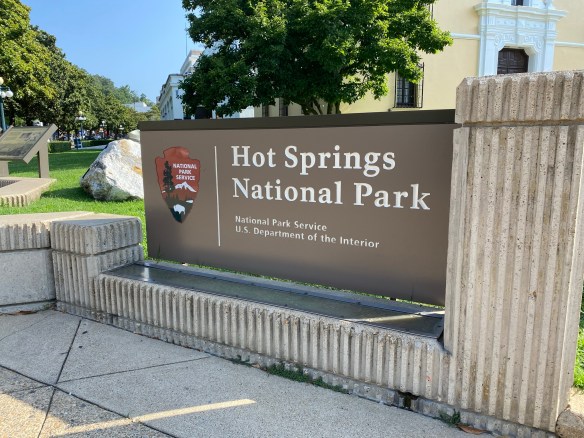
Indigenous people have been quarrying stone from this area of Arkansas for thousands of years. After an exploration expedition in 1804, sent by President Thomas Jefferson, the hot springs were discovered and shortly afterwards, Europeans arrived and began utilizing the geothermal springs. There was talk that the spring waters had healing abilities. A town grew in the area of the springs that later became known as Hot Springs. The resulting bathing industry was built around the geothermal springs coming from the Hot Springs Mountain. This later became known as the “American Spa”.
In 1832, President Andrew Jackson signed legislation to preserve “…four sections of land including said (hot) springs, reserved for the future disposal of the United States (which) shall not be entered, located, or appropriated, for any other purpose whatsoever.” This proclamation meant that Hot Springs National Park was actually the very first, and now the oldest, national park in the current national park sites. Unfortunately, there was no accompanying legislation that prohibited building or settling in or around the area, which meant that people continued to build around and over the springs.
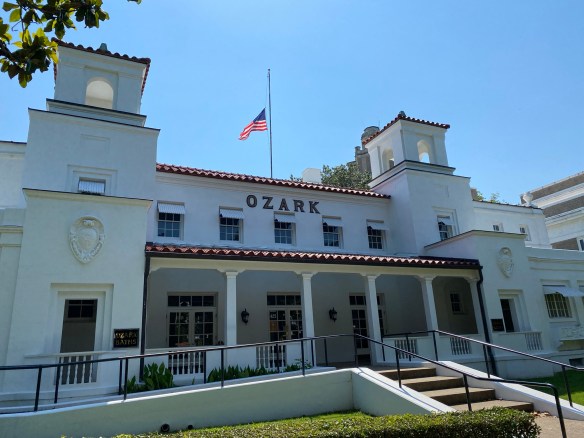
Victorian bath houses built between 1880-1888 were considered large and luxurious, but by the early 1900’s, they were eventually replaced with fire-resistant brick and stucco. This was a precaution due to a severe fire in 1878 which decimated south and central downtown Hot Springs. In contrast to the previous structures, these newly built bath houses featured marble walls, billiard rooms, and gymnasiums. The culmination of changes to Bathhouse Row was completed when the Lamar Bathhouse opened its doors for business in 1923. These bathhouses are all still standing today.
After the Civil War reconstruction era, African Americans found that they could work at the bath houses but they still could not receive services from the bathhouses so they built and maintained many of their own bath houses. African American bathhouse attendants were an integral part of the bathing industry in Hot Springs. They organized to protect their pay and professions from exploitation. And in the early 1900’s, African American residents built the first bathhouse used exclusively by African Americans. For a more in depth look at how African Americans impacted the bathing industry at Hot Springs, visit the NPS link about Bathhouse Attendants at Hot Springs National Park.
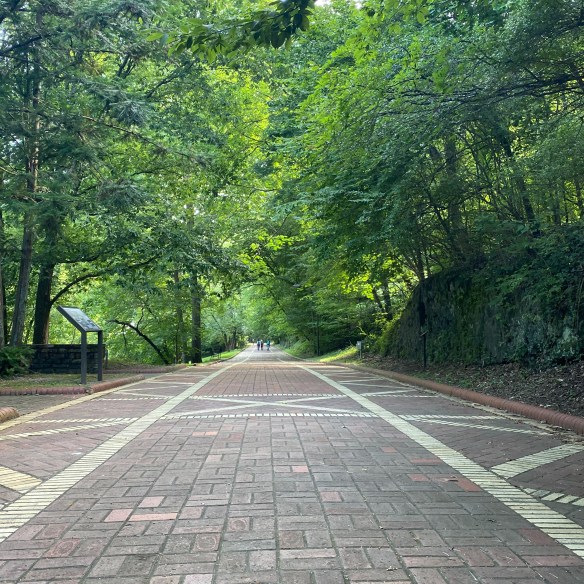
Take a short walk along the Grand Promenade. This walk runs behind the eight bathhouse buildings that were built between the years 1892-1923. Most of these buildings are open to the public with Fordyce functioning as the park’s visitor center. They can be accessed from Central Avenue. The Fordyce Bathhouse is open every day from 9:00-5:00pm, with the exception of Thanksgiving Day, Christmas Day, and New Years Day.
Today, there are only two bath houses where you are permitted to soak in the springs: the Buckstaff and the Quapaw. There are no entrance fees for the park but because this park encircles a city, you will probably have to pay for parking somewhere in the general area. This is one of the national parks that allows pets! Pets are welcome in the park and on the trails but not in the federal buildings. There is a cell phone tour available for Bathhouse Row so you can stop and listen along the way. If you decide to visit in the summer months, be prepared for the heat! Drink lots of water and wear a hat!
Accessibility: The Fordyce Visitor Center, Gulpha Gorge Campground, other park buildings, and all park bathrooms have functional ramps and are accessible to all persons. Bathhouse Row is paved and has a four to five foot wide walkway that creates a circular loop around the block. There are benches with backs along the Grand Promenade if you need to sit down and rest. There are two wheelchairs available to loan free of charge for use in the Fordyce Bathhouse Visitor Center and Museum. There are tactile exhibits along with self-guided tour books in braille as well as audio descriptions some exhibits and the park films. ASL interpreters are available for guided tours, but you must submit a request two weeks in advance. There are two accessible trails in the park. The Grand Promenade is a half-mile (one-way), fully paved trail with ramp access off Fountain Street and another behind the Fordyce Bathhouse. Whittington Park Trail is a 1.2 mile gravel trail that is a flat but unpaved loop.
MILE MARKER: The water in the hot springs is over 4000 years old! The thermal water that bubbles up in the park today fell as rain over 4,000 years ago. It percolates deep underground, gets heated by the earth’s geothermal energy, and reemerges through the Hot Springs Fault. So when you step into those bathhouses, you’re literally soaking in ancient rainwater!
HIKE IT!: There are over 20 miles of hiking trails in and around the Hot Springs National Park! Levels vary but there are plenty of options for anyone looking to get out of the city and into nature. Paper trail maps can be obtained at the Fordyce Bathhouse and Visitor Center and digital maps with real-time GPS location are available by downloading the service-wide NPS App. Make sure you check at the visitor center before starting your hike just in case there have been any updates or closures.
 Two Chicks with Hiking Sticks