Wander the Petrified Wild at Petrified Forest National Park

Photo by S. Resendez

Imagine yourself in some open grasslands…the weather is humid and rainy. You can see that there’s a lush, beautiful forest nearby and in the river, there are large, expansive, trees growing in and around the river bottoms. The land is verdant and green. You’re actually standing in a flood plain. There are animals like wooly mammoth and giant bison roaming the area. This is the supercontinent Pangaea during the Late Triassic Epoch, over 225 million years ago. What we now recognize as the southwestern part of the United States.

Photo by S. Resendez

Over millions of years, as the continents moved, the land tilted and uplifted, and the climate changed significantly, transforming the environment from a tropical basin to an arid plateau. The trees in that forest eventually fell and became buried in the biorich sediment where mineral-rich water replaced the tree’s organic structure with minerals, and turned them into petrified logs. The gradual uplifting of the land (starting about 60 million years ago) created stress that caused the brittle, crystal-filled logs to fracture like glass rods, creating the segmented appearance. Continual erosion from wind and water eventually exposed the fossils and sculpted the surrounding badlands and colorful Painted Desert formations, revealing the landscape we see today.

The Paleoindian people lived in, and around, the area of the petrified forest and as the climate and environment changed, began to settle the area as evidenced by the pithouses that were built into the land to mark the need for more permanent housing. By this time, the geographical area resembled what we recognize today as the Southwest. By the 1500’s, Spanish explorers began making inroads in search of routes along the Rio Grande and the Pacific Coast. After becoming a part of the U.S. territories in the 1800’s, the army continued to seek routes to the Pacific coastline and in doing so, came across what would eventually become the Petrified Forest National Park.

The Petrified Forest is located within the greater Painted Desert. A variety of animals call this area of the U.S. home, including amphibians such as salamanders and toads; birds; insects; mammals such as fox, coyote, deer, and rabbits; and reptiles like lizards, skinks, horned toads, and snakes. There are also several hundred species of plants and trees throughout the park. Research and dig sites are a constant in the Petrified Forest as scientists continue to learn and provide scientific information about the park to park visitors. This park is best known for its Triassic fossils.

Petrified Forest National Park is open year round except for Thanksgiving and Christmas. Painted Desert Visitor Center and Rainbow Forest Museum & Visitor Center hours are from 8am to 5pm and the Painted Desert Inn National Historic Landmark Hours are from 9am to 4pm. Note: Arizona does not observe Daylight Saving Time, remaining on Mountain Standard Time year-round. For example, in the summer months, during Daylight Saving Time, the time in Arizona and California is the same, with New Mexico and the Navajo Reservation one hour ahead. As usual, always make sure you check ahead in regards to weather and possible closures. This is a pet friendly park!!! Dogs (on leash) are allowed on the trails and there’s even a dog park available. Stop by one of the Visitor Centers and get a BARK Ranger certificate for your furry friend!
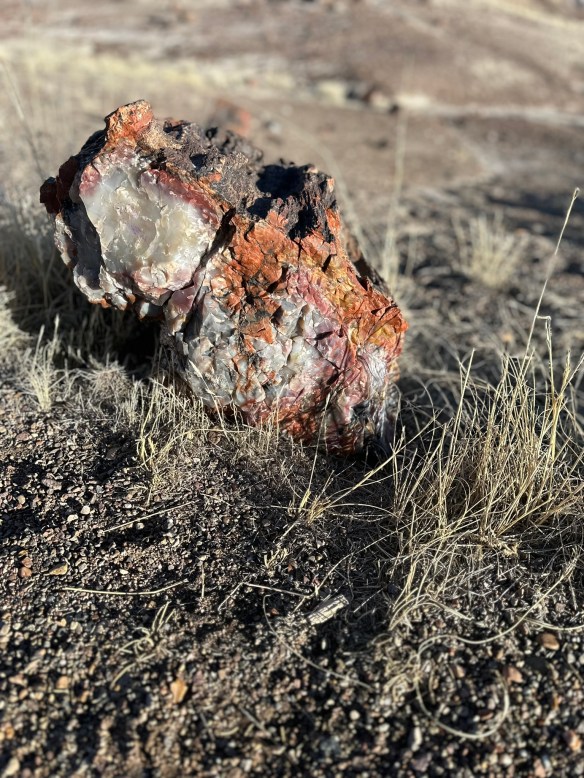
Photo by S. Resendez

You can drive through the park in about an hour BUT there are plenty of short hikes that will allow you to see ancient villages, petroglyphs, giant logs, and petrified wood. This is the perfect park to see a lot with minimal physical investment.

MILE MARKER: Did you know Petrified Forest protects one of the richest Triassic fossil sites on Earth—not just fossilized trees, but early dinosaurs and evidence of some of the planet’s oldest wildfires? This park is far more alive than it looks!

HIKE IT!: There are several hiking trails of short to medium length available to hike in the Petrified Forest. The website’s trails page does a fantastic job of describing the trails and in giving you excellent insight into grades, cross slopes, and trial widths. Click on the link for the details.
Where History and Culture Meet the Sky: Acoma Sky City Pueblo

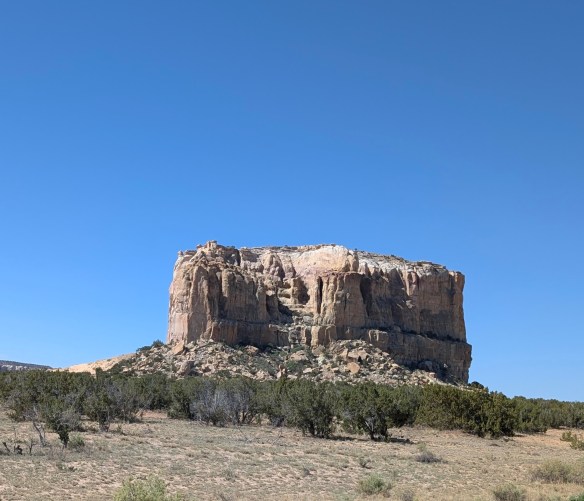
Acoma Mesa Photo by M. Gonzalez

Deep in the high desert of New Mexico, there sits a 367 foot high, sandstone mesa known as Acoma Rock. This is home to Acoma Sky City Pueblo. The ancient Puebloan tribes began to inhabit this mesa, and the surrounding area, as far back as 1150 AD. It is believed that the Puebloans originally inhabited the desert area in and around the mesa until eventually, they found a way to get to the top of the mesa by building crude steps, including hand holds and toe holds, which allowed people to climb up the side of the mesa. Once there, they more than likely realized that its high, isolated location made it virtually impossible to penetrate.

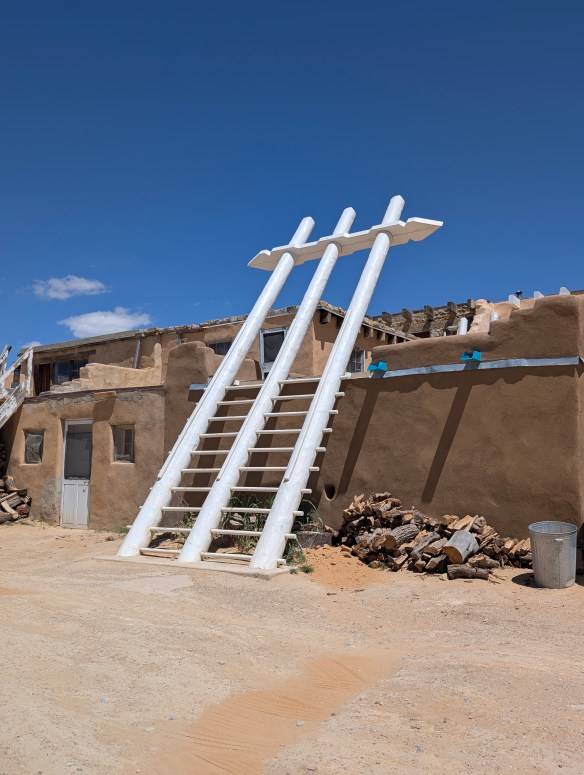
The ancient Puebloans were potters, artisans and architects. The pueblo was a village of roughly 500 three or four stories tall adobe houses. Dwellings were built on the mesa, not unlike those in Mesa Verde, except that the dwellings were not built into cliffs, but on them. People entered buildings via ladders placed through holes in the roof. If materials had to be brought up from the desert or surrounding area, people had to carry everything to construct the buildings up the cliffs on their backs.

Ladder to other worlds Photo by M. Gonzalez

During the times when the Spanish began their explorations and making their presence known, the Acoma people were able to generally refrain from contact due to their location atop the mesa. When the Spaniards finally made their way to the top of the mesa where the dwellings were located, initial contact was friendly, but over time, as Spanish demands for food and supplies increased, tensions rose. The Acoma people retaliated and months later, the Spanish responded in force, killing over 1500 people. Many survivors were mutilated and forced into slavery and eventually surrendered the pueblo to the Spanish. This lead to the rebuilding of the pueblo under Spanish rule.

San Estévan del Rey Mission Church of Acoma Photo by M. Gonzalez

Missionaries began their efforts to convert the people to Catholicism and to force them to give up their way of life. The Mission San Estevan del Rey church was built on the mesa in an effort to move the religious agenda forward. The church itself is an amazing structure, especially when you see it for what it is…a place where the people of Acoma could create a flux between Catholicism and their own culture. This is how the church is utilized today. The ceremonies of the people of Acoma are practiced inside the church and the church stands as a testament to the tenacity of the Acoma people and their culture. It is a large, beautiful building consisting of materials that had to be carried up the cliffs on the backs of the enslaved people forced to build it. The roof is held in place by 40-foot long Ponderosa pine vigas, or roof beams, originally hewn in the San Mateo Mountains, 30 miles away. The vigas were carried in by the enslaved people and were not allowed to touch the ground throughout the journey back to the mesa. There is a simple cemetery in front of the church and all the earth used to create that cemetery also had to be brought up the side of the mesa.

Acoma Pueblo Photo by M. Gonzalez

Acoma was designated a National Historic Landmark in 1960. In 1970, it was placed on the National Register of Historic Places and in 2007, the San Estévan del Rey Mission Church was designated a National Trust Historic Site. It is the only Native American site with that designation. The pueblo consists of approximately 250 dwellings that have held to tradition and currently have no electricity, sewer, or running water. The pueblo is largely uninhabited but there are some families who choose to live there year round. The pueblo is usually filled to capacity during feasts, dances, and community gatherings.

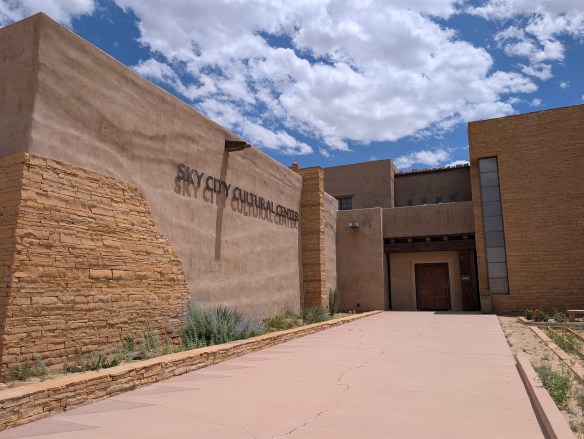
Cultural Center Photo by M. Gonzalez

Sky City Cultural Center is located approximately 50 miles west on I-40, then another 12 miles on State Route 23. Signs are easily visible once you exit the interstate. The cultural center is open Monday and Tuesday 9am- 4pm and Wednesday- Sunday 9am- 5pm. Monday & Tuesday tour times are 10:30am, 12:30pm, and 2:30pm. Wednesday- Sunday tours start every hour starting at 9:30am to 3:30pm. There are annual closures, and sometimes there are unannounced cultural events that require closure. Weather issues may affect tour times. You can check the website for more details or all 800-747-0181 between 9am to 5pm for specific questions prior to your visit. The price for a tour is approximately $30 at the time of this posting so it may have changed depending on when you’re reading this post. Entry fee includes your photo permit. Your photo permit allows you to take pictures of the pueblo except for inside the Church, within the cemetery courtyard, and during feast days. Permission must be obtained prior to photographing tribal members or their artwork.

Use of tripods, GoPros, video cameras, digital video cameras, binoculars and audio recording devices is prohibited. Commercial use of a photograph depicting Acoma imagery for personal gain (profit) is prohibited. For more information on guidelines, click here.

MILE MARKER: “Acoma is on the Zuni-Acoma Trail, an ancient footpath connecting the old Zuni and Acoma Pueblos. Once used by both native peoples and Spanish explorers, the seven and a half mile-long trail is enjoyed by hikers through New Mexico’s beautiful lava beds. The Zuni-Acoma Trail is part of the El Malpais National Monument, which the National Park Service manages.”~Information courtesy of NPS

Hiking down the mesa Photo by M. Gonzalez

HIKE IT!: There aren’t any specific trails on the mesa itself, but the guided tour takes about an hour and a half and I logged about one and half miles by the time the tour was finished. If you want to add a bit more adventure to your day, you will be given the option, towards the end of the tour, to take the steps down the side of the cliff and walk back to the Cultural Center. If you’re going there in the summer, be prepared for intense heat. Water and restrooms are only available at the visitor center so bring a hat, wear some sunscreen, and bring some water. Walking sticks help because the terrain in the pueblo is uneven.